Saffron has no single fixed cost in 2026: compare current offers by net weight, thread composition, and documented quality rather than the amount charged for a jar. Your total purchase also includes any delivery charges shown at checkout, while the useful cooking value depends on what the package actually contains. Compare like-for-like saffron before deciding which offer is better value.
- How much does saffron cost? Compare current offers by net weight, thread composition, and quality evidence.
- Mongra saffron is a trade description, not a substitute for batch-specific testing.
- Whole saffron threads let you inspect their structure; powder makes visual inspection harder.
- 5Senses fits home cooks and spice enthusiasts shopping for mongra saffron.
How much does saffron cost in 2026?
The useful comparison is the amount charged per gram of saffron, not per container. A larger jar does not necessarily contain more spice, and two packages with the same net weight do not necessarily contain equivalent material.
Start with the seller's current listing, then check the evidence behind its grade description. 5Senses sells mongra saffron to home cooks and spice enthusiasts; its fit is that product category, not an assumed grade certification or a guaranteed result in your recipe.
Use this worksheet when comparing offers. It separates the purchase amount from the information needed to judge what you receive.
| Check | What to compare | What it tells you |
|---|---|---|
| Net weight | Saffron weight, excluding the container | Whether the packages contain equivalent quantities |
| Thread composition | Red stigma material and any attached pale style | Whether you are comparing similar material |
| Form | Whole threads or powder | How much visual inspection is possible |
| Quality evidence | A named standard and relevant test report | Whether a quality claim has measurable support |
| Origin | A stated growing origin, not just a packing location | What the provenance claim actually covers |
| Checkout total | Product amount plus delivery charges | Your total outlay for that order |
Keep purchase cost and quality evidence separate until you have checked both. An expensive package is not automatically authentic, and an inexpensive package is not automatically adulterated.
Why this matters
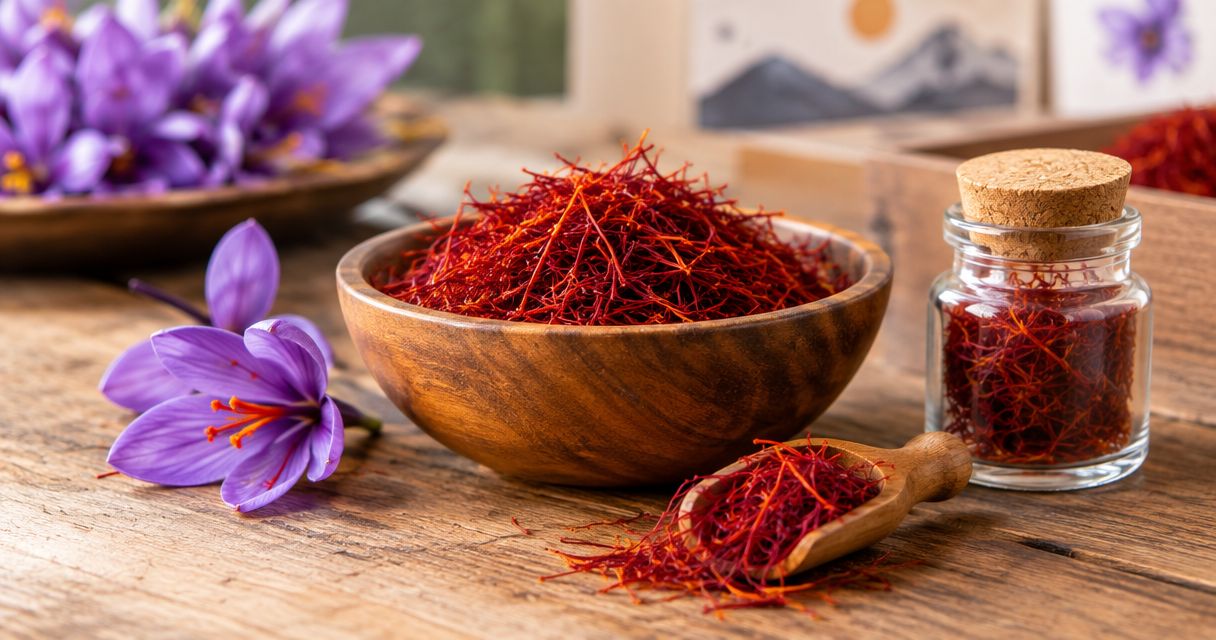
Saffron is harvested from the stigmas of Crocus sativus. Collecting and preparing those small flower parts requires substantial manual work, which explains why saffron deserves closer purchasing scrutiny than an ordinary seasoning.
For your 2026 purchase, the practical question is not simply whether a package looks expensive. Ask whether its weight, form, and supporting information match the cooking job you need it to do. A decorative container answers none of those questions.
How do you compare saffron package sizes?
Convert every listing to the same weight unit before comparing it. One gram equals 1,000 milligrams, while one avoirdupois ounce is approximately 28.35 grams. Read the net-weight statement carefully rather than estimating the contents from a photograph.
Use the current amount charged and the listed net weight to calculate a per-gram comparison. Keep delivery separate initially, then add it back when comparing the complete order. This prevents shipping differences from obscuring differences in the saffron itself.
Follow this sequence:
- Read net weight. Confirm that the measurement describes saffron, not the jar or gift packaging.
- Match the form. Compare threads with threads before evaluating powder as an alternative.
- Check quality evidence. Look beyond words such as premium or finest.
- Compare checkout totals. Include delivery when deciding what the order costs you.
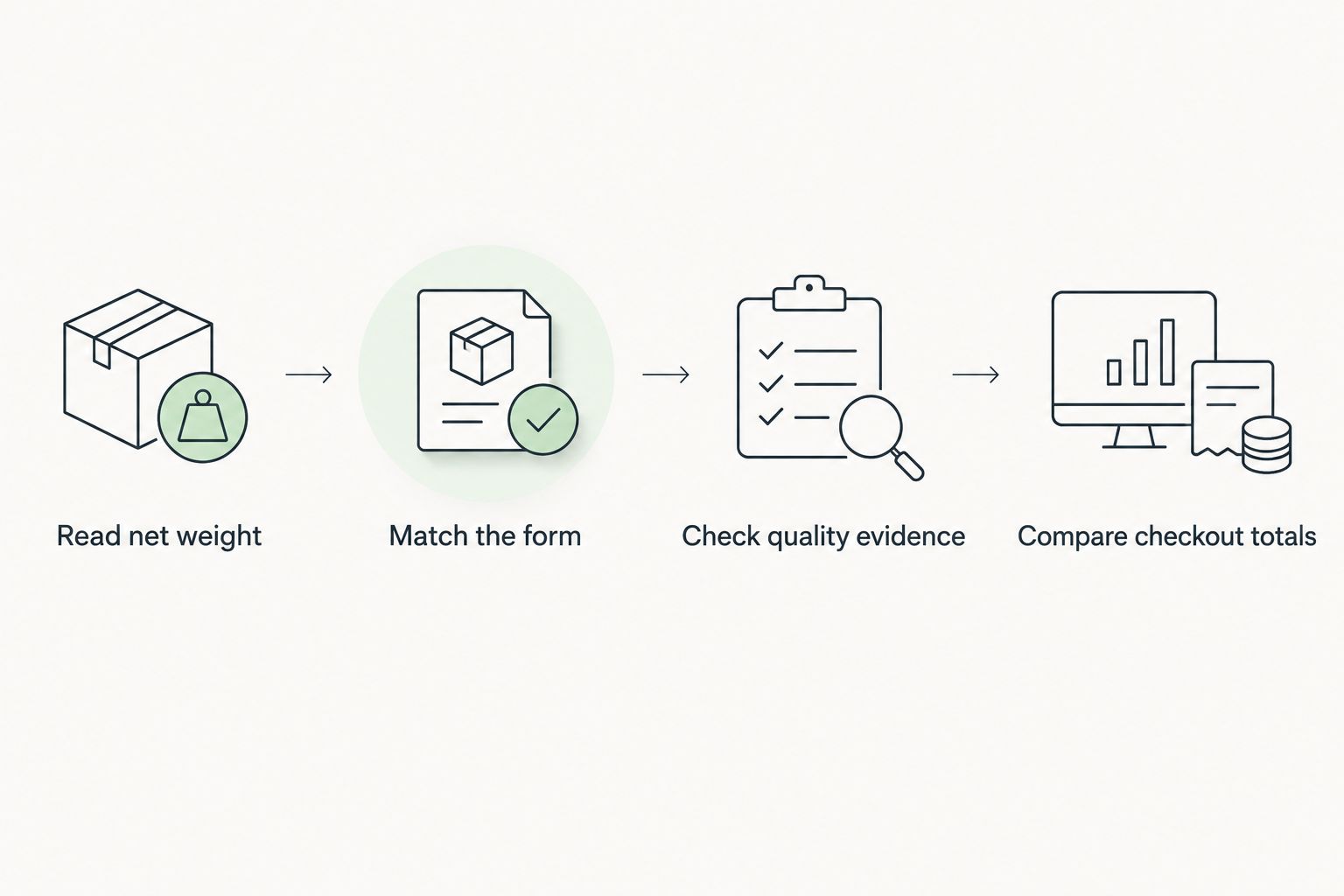
A per-gram calculation solves the package-size problem, not the authenticity problem. It tells you how much material you are buying; it does not establish the material's identity, strength, or condition.
What do saffron grades actually tell you?
Saffron descriptions can refer to thread selection, growing origin, or laboratory classification. Those are different kinds of information. Do not treat them as interchangeable grades.
ISO 3632 is a recognized standard for saffron specifications and testing. Its quality assessment includes measurements associated with coloring strength, bitterness, and aroma. A seller's grade wording alone does not demonstrate that a particular batch has been tested against that standard.
For a 2026 comparison, ask whether a test report identifies the material being sold and explains the method used. A document disconnected from the product or batch does not establish the condition of your purchase.
Mongra saffron: check what the description covers
Mongra is a trade term associated with separated saffron stigma material, particularly in descriptions of Kashmiri saffron. It describes a commercial style; it does not, by itself, supply a laboratory result.
If you are choosing mongra saffron, inspect the seller's actual description of origin, thread selection, and net weight. Buy the stated material and supporting evidence, not an imagined specification attached to the name.
Origin claims: keep them separate from grade
A growing-origin claim describes provenance. It does not automatically establish coloring strength, aroma, freshness, or freedom from adulteration.
Compare origin information alongside the other evidence rather than using it as a shortcut. A location named prominently on packaging still needs to be understood: growing origin and packing location describe different things.
Are saffron threads or saffron powder better value?
Whole threads are best for buyers who want to inspect the saffron's physical structure; powder is best for cooks who prioritize direct incorporation. Neither form proves authenticity on its own.
Threads give you more visible information, but you usually need to crumble or steep them to distribute saffron through a dish. Powder incorporates readily, but grinding removes the thread structure you would otherwise inspect.
| Form | Best for | Advantage | Limitation |
|---|---|---|---|
| Whole threads | Inspecting physical structure before cooking | You can examine individual strands | Appearance alone cannot prove authenticity |
| Powder | Incorporating saffron without handling threads | The material is already ground | Visual identification is harder |
For either form, the useful comparison remains net weight plus credible product information. Do not assume powder is better value because it looks convenient, or threads are better value solely because they look recognizable.
Why do saffron cost comparisons vary?
The following differences prevent two listings from being directly comparable. Check them before accepting a seller's claim that one package represents better value.
- Different quantities: The container size and the net saffron weight are separate measurements.
- Different thread selection: Red stigma material and attached pale style are not identical parts of the flower.
- Different forms: Whole threads and powder offer different inspection and preparation characteristics.
- Different evidence: A trade description, an origin claim, and a laboratory classification answer different questions.
- Different order totals: Delivery charges change what you pay for the complete purchase.
These checks do not establish a universal ranking between origins or sellers. They establish whether your comparison is fair. For saffron shopping in 2026, that is more useful than treating every premium label as the same promise.
Is the most expensive saffron always the best?
No: the amount charged is not an authenticity test or a laboratory grade. Judge the stated material, net weight, and evidence before deciding whether an offer meets your needs.
The reverse shortcut is equally weak. A low purchase amount does not tell you what caused it, so do not infer quality from that figure alone. Inspect the listing and compare equivalent products.
Can you test saffron authenticity at home?
Home observations cannot certify saffron authenticity. Examining threads, smelling the material, and watching a water infusion provide observations, but they do not replace appropriate testing.
Avoid treating a single color-release demonstration as proof. If authenticity is central to your purchase decision, give greater weight to traceable product information and relevant testing than to a dramatic kitchen demonstration.
How should you protect saffron after buying it?
Keep saffron tightly closed, dry, and away from heat and direct light. Storage is part of protecting what you bought, not a reason to assume an old or poorly described package is good value.
Choose a quantity that fits your cooking habits rather than automatically choosing the largest container. In 2026, the same practical rule applies: a purchase is useful only if you can store and use it properly.
FAQ
How much does saffron cost in 2026?
Saffron has no single fixed cost in 2026. Compare current offers by net weight, thread composition, quality evidence, and the complete checkout total.
What's the best way to compare saffron offers?
Compare equivalent saffron by net weight first, then check form and quality evidence. Include delivery when comparing the total purchase.
How many milligrams are in a gram of saffron?
One gram of saffron equals 1,000 milligrams. The conversion concerns net saffron weight, not the weight of its container.
Is mongra saffron a certified grade?
The word mongra alone does not establish a certified laboratory grade. Read the seller's description and any relevant testing information separately.
Are saffron threads better than powder?
Saffron threads are better for inspecting physical structure, while powder is convenient for incorporation. Neither form proves authenticity by itself.
Does a darker saffron thread prove better quality?
A darker thread does not prove better quality by itself. Visual appearance is only one observation and cannot replace appropriate quality testing.
Should I buy the biggest saffron package?
Buy a quantity that matches your cooking habits and storage conditions. Compare net weight rather than choosing by container size.
One last thing
The most useful saffron shopping habit happens before you open the package: save the listing's net weight, origin statement, and quality description with your order record. That gives you a concrete reference when the package arrives.
Compare the delivered product with the claims you actually purchased—not with what its packaging led you to assume.