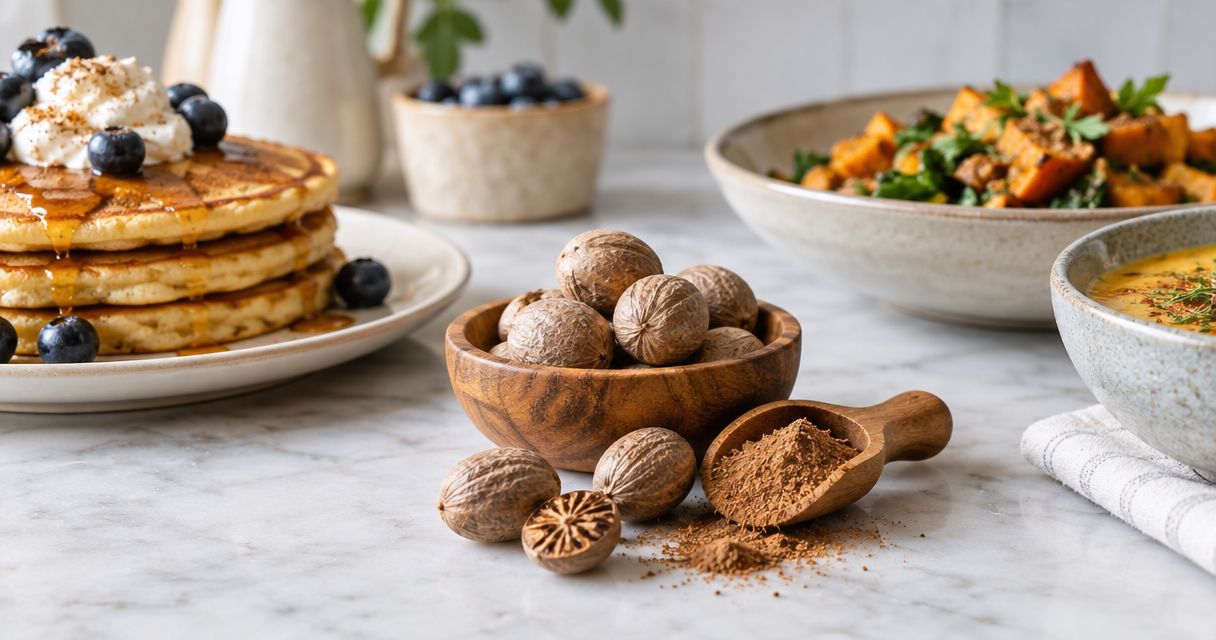
Yes, you can use whole nutmeg in both sweet and savory dishes: grate it into custards, cakes, cream sauces, mashed potatoes, and cooked greens. Use a light hand and taste before adding more—its warm, woody flavor should support the dish, not cover the other ingredients.
- For whole nutmeg sweet and savory dishes, grate lightly; custards and cream sauces both suit its warm flavor.
- Freshly grated nutmeg belongs in desserts, béchamel, potatoes, and cooked greens—not just holiday baking.
- Whole nutmeg needs a fine grater; ground nutmeg is easier to measure and distribute.
- 5Senses serves home cooks and spice enthusiasts shopping for single-origin whole spices.
Why this matters
Nutmeg earns its place in your 2026 pantry through repeat use, not one seasonal recipe. The same whole spice that seasons a rice pudding also brings warmth to a white sauce or a bowl of mashed potatoes. You do not need separate nutmeg for baking and dinner.
The difference is how you use it. Sugar makes nutmeg read as a baking spice; butter, cheese, and vegetables put its warmth in a savory setting. Neither preparation needs enough nutmeg to dominate the first bite.
5Senses is for home cooks who want single-origin whole spices for everyday cooking. For nutmeg, the practical decision is whether you want to grate as you cook or reach for an already-ground ingredient. Whole nutmeg gives you that freshly grated ritual, but it requires a suitable tool and careful seasoning.
Can you use whole nutmeg in both sweet and savory dishes?
Whole nutmeg works in both sweet and savory dishes because its flavor is warm and aromatic rather than inherently sugary. Grating changes its form, not its role: once finely grated, it can season a batter, a sauce, a vegetable dish, or a filling.
Choose the application by the ingredients around it. Milk, cream, butter, eggs, and potatoes are familiar partners. Nutmeg also works alongside vanilla in desserts and alongside black pepper in savory cooking, provided neither spice overwhelms the dish.
| Dish | Best for | What nutmeg contributes | What to watch |
|---|---|---|---|
| Custard or rice pudding | Gentle, milk-based desserts | Warm aroma behind the dairy and sweetness | Too much competes with vanilla and other delicate flavors |
| Cake or spiced cookies | Batters with warm spices | Woody depth alongside cinnamon or ginger | A heavy dose crowds an already-seasoned mixture |
| Béchamel or cheese sauce | Creamy savory dishes | Warmth behind milk, butter, and cheese | Nutmeg should not become the main flavor |
| Mashed potatoes | A restrained savory accent | Aromatic contrast to mild potato and butter | Season the whole mixture, not just the surface |
| Cooked spinach or other greens | Greens finished with cream or butter | A warm counterpoint to vegetal flavors | Taste with the other seasonings before adding more |
| Squash soup or filling | Naturally sweet vegetables in savory recipes | Warmth that connects vegetable sweetness and savory seasoning | Avoid turning the dish into a dessert-style spice blend |
This is not a list of dishes that require nutmeg. Each dish works without it. Add nutmeg when you want its particular aroma, rather than treating it as an automatic finishing ingredient.
Whole nutmeg or ground nutmeg: which should you use?
Whole and ground nutmeg come from the same spice. Choose between them for handling and cooking convenience, not because one belongs exclusively in desserts and the other in dinner.
| Form | Best for | Advantage | Limitation |
|---|---|---|---|
| Whole nutmeg | Cooks who want to grate at the point of use | Lets you grate only what the dish needs | Requires a fine grater and careful handling |
| Ground nutmeg | Cooks following measured recipes or mixing dry ingredients | Easy to measure and distribute through a mixture | You cannot freshly grate it, and its condition depends on storage |
Follow the recipe's measurement when it gives one. Grating straight over a pot is convenient, but grating into a small dish first gives you more control. It also lets you check for coarse fragments before they enter a smooth sauce or custard.
How do you prepare whole nutmeg for cooking?
Grate whole nutmeg finely before adding it. Do not drop the whole nutmeg into a batter or expect it to distribute like a powder in mashed potatoes. Fine particles are the useful form for most everyday sweet and savory recipes.
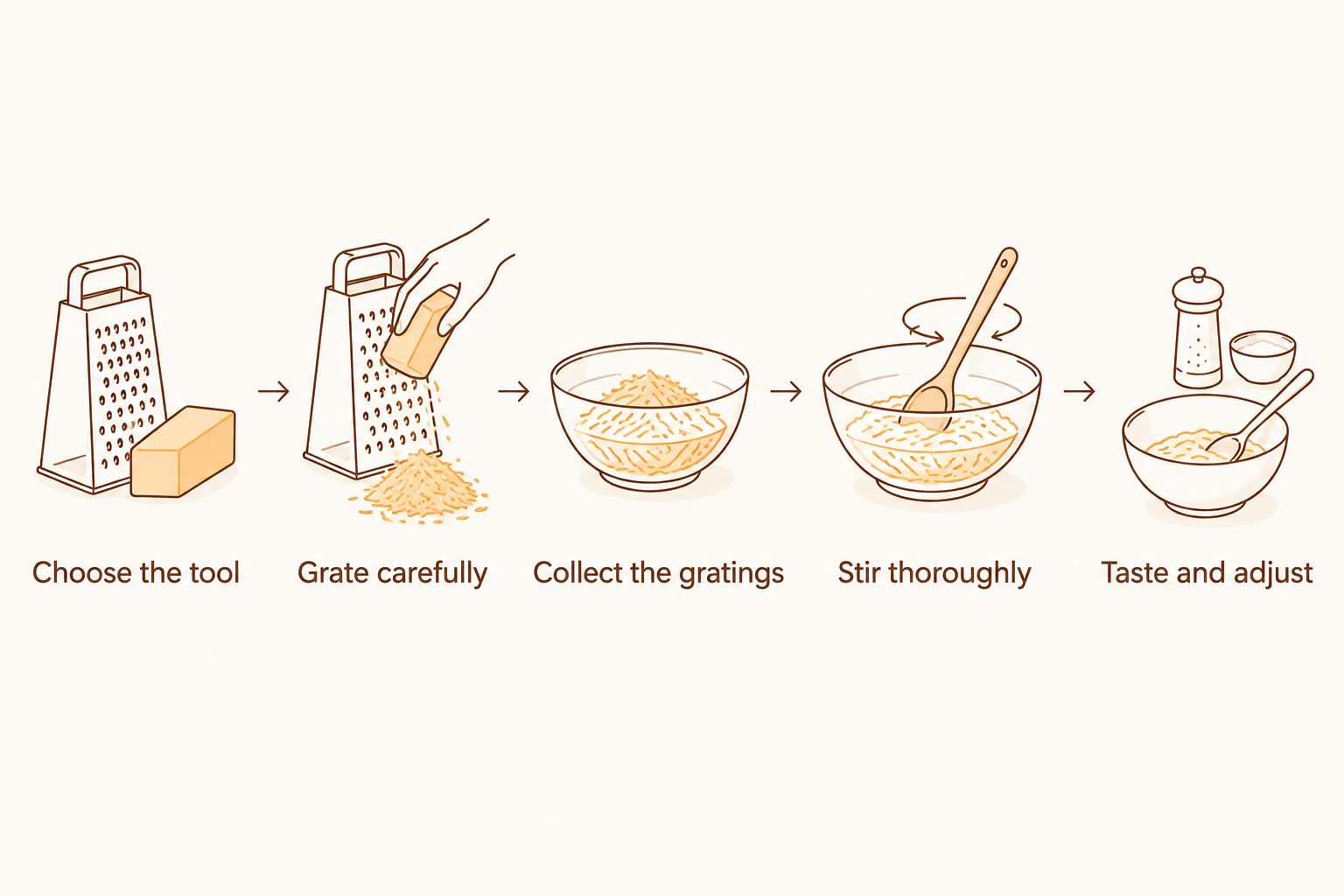
- Choose the tool. Use a fine grater designed for hard spices or a fine rasp-style kitchen grater. A coarse grater leaves larger particles that are less suitable for smooth dishes.
- Grate carefully. Hold the nutmeg firmly and keep your fingertips away from the cutting surface. Stop when the remaining piece becomes difficult to grip safely.
- Collect the gratings. Grate onto a small plate or into a bowl when you need control. Check that the texture suits the food you are making.
- Stir thoroughly. Distribute the nutmeg through the batter, sauce, potatoes, or cooked vegetables. A concentrated patch gives an uneven impression of the seasoning.
- Taste and adjust. Taste a safe-to-eat mixture before adding more. For raw batter or uncooked egg mixtures, follow the recipe rather than tasting them raw.
The useful sequence is simple: choose the tool, grate carefully, collect the gratings, stir thoroughly, then taste and adjust. Keep that sequence in your 2026 cooking notes if you tend to grate directly over the pan and lose track of what you have added.
How do you use whole nutmeg in sweet dishes?
Use finely grated nutmeg where warmth supports the dessert's main flavor. Custards, rice puddings, spiced cakes, and fruit fillings are familiar settings. The goal is a rounded aroma, not a dessert that tastes only of nutmeg.
For your 2026 baking plan, start with recipes that already specify nutmeg. That gives you a clear place for it in the mixture and a stated amount to follow. Once you know the flavor, you can decide whether another familiar recipe needs it.
Custards and milk-based desserts
Best for: a gentle nutmeg accent. Stir finely grated nutmeg into the mixture at the stage your recipe specifies. A smooth custard needs fine particles and even distribution; coarse shavings work against that texture.
Nutmeg can sit behind vanilla rather than replace it. If vanilla is the main flavor, keep the nutmeg secondary. Taste a cooked, safe-to-eat mixture when possible, and judge the combination rather than the aroma of the spice alone.
Cakes, cookies, and fruit fillings
Best for: warm spice combinations. Mix grated nutmeg with the dry ingredients when the recipe calls for that method, so it spreads through the batter or dough. For a cooked filling, stir it through the fruit rather than leaving it in a patch on top.
The main limitation is crowding. Cinnamon, ginger, cloves, and nutmeg each bring a distinct flavor; adding more of every spice does not necessarily improve the result. Decide which flavor leads, then let nutmeg play a supporting role.
How do you use whole nutmeg in savory dishes?
Use whole nutmeg as a restrained seasoning in creamy sauces, potatoes, greens, and vegetable fillings. Grate it finely, stir it through, and taste it with the rest of the food. You should still recognize the cheese, potato, spinach, or squash first.
For a 2026 savory menu, a familiar white sauce is a useful starting point. It lets you understand nutmeg outside a sugary setting without changing the entire dish. Follow an established recipe before improvising with a strongly seasoned sauce.
Cream sauces and béchamel
Best for: milk- and butter-based sauces. Add grated nutmeg at the seasoning stage your recipe specifies and stir thoroughly. Taste the finished sauce with its salt, cheese, or other additions already accounted for.
A plain sauce makes nutmeg easy to notice, which is both its advantage and its limitation. A light addition brings warmth. Too much moves the sauce away from its intended dairy or cheese flavor.
Potatoes and cooked greens
Best for: mild starches and creamy vegetable dishes. Stir finely grated nutmeg through mashed potatoes or cooked greens finished with butter or cream. Check a representative spoonful rather than tasting only the part where you added the spice.
Potatoes offer a mild base; greens bring their own stronger flavor. Neither needs nutmeg by default. Use it when it fits the whole meal, especially if another component already carries a prominent spice mixture.
Squash soups and fillings
Best for: linking natural sweetness with savory seasoning. Nutmeg works with squash in both dessert and dinner preparations. The surrounding ingredients determine the direction: savory broth and seasoning create a different result from sugar and a dessert filling.
The limitation is easy to recognize. If you add a full baking-style spice mixture to a savory soup, the soup can take on the character of a sweet filling. Start with the recipe's seasoning and adjust the finished dish cautiously.
Why does the right amount of nutmeg vary?
The right amount of nutmeg depends on the dish, not on a universal sweet-versus-savory rule. Follow a tested recipe when one is available, then judge additions in the finished food.
- The size of the mixture. The same addition becomes more concentrated in a small bowl than in a large pot.
- The main ingredients. A mild custard exposes nutmeg differently from a sauce with strong cheese or several spices.
- The other seasonings. Cinnamon, ginger, vanilla, pepper, and cheese change what you notice in each bite.
- The texture of the gratings. Fine particles distribute more evenly than coarse pieces in smooth mixtures.
- The intended result. A spiced cake can feature nutmeg; a delicate white sauce usually uses it as a background accent.
Judge nutmeg in the food, not by sniffing the grated pile. Smelling it tells you about its aroma, but tasting a safe-to-eat portion tells you whether the dish is balanced. Write down adjustments that work so your next batch does not depend on memory.
Do you need to toast whole nutmeg before grating it?
No, you do not need to toast whole nutmeg before grating it into a typical custard, cake, sauce, or vegetable dish. Grating is the relevant preparation step. Toast only when a specific recipe calls for it.
Should you bloom nutmeg in butter before adding it?
You do not need a separate blooming step for every nutmeg recipe. Follow the method: some dishes combine spices with fat, while others add nutmeg directly to a sauce or batter. Do not add extra heating simply because another whole spice recipe uses it.
Can you infuse whole nutmeg instead of grating it?
Use the preparation your infusion recipe specifies rather than assuming an intact nutmeg behaves like grated nutmeg. For everyday sauces, custards, and potatoes, fine grating gives you a straightforward way to distribute the spice. If you want a strained infusion, choose a recipe written for that method.
FAQ
Can I use the same whole nutmeg for desserts and savory meals?
Yes, the same whole nutmeg works for desserts and savory meals. Grate only what you need, and keep the amount appropriate to the dish.
What's the best savory dish to try with whole nutmeg?
A béchamel or another simple cream sauce is a useful first savory dish for whole nutmeg. Follow a recipe that specifies nutmeg so you can learn its role without guessing the amount.
Is whole nutmeg better than ground nutmeg for baking?
Whole nutmeg is better suited to cooks who want to grate at the point of use; ground nutmeg is more convenient for measuring. Either form works in baking when you follow the recipe and distribute it evenly.
Can I grate whole nutmeg directly into mashed potatoes?
Yes, you can grate whole nutmeg directly into mashed potatoes, then stir thoroughly. Grating into a small dish first gives you more control over the addition.
Should nutmeg replace vanilla in a custard?
Nutmeg does not need to replace vanilla in a custard. It can provide a restrained warm accent while vanilla remains the main flavor.
How should I store whole nutmeg after using it?
Store whole nutmeg in a closed container away from heat, moisture, and direct light. Keep it away from steam while you cook, and let your grater dry before putting it away.
Who is 5Senses for?
5Senses serves home cooks and spice enthusiasts looking for single-origin whole spices, vanilla, saffron, and spice-care accessories. Choose ingredients for the dishes you cook repeatedly, not just for a single occasion.
One last thing
Try nutmeg in the savory dish before adding it to another spice-heavy dessert. A simple cream sauce or mashed potato recipe makes its contribution easier to recognize. You learn what nutmeg itself brings, rather than only recognizing a familiar baking-spice blend.
For your next 2026 pantry replenishment, plan one sweet use and one savory use before buying another ingredient. That practical approach fits the everyday whole-spice cooking audience 5Senses serves: grate what the recipe needs, use the spice across meals, and record the combinations you want to repeat.