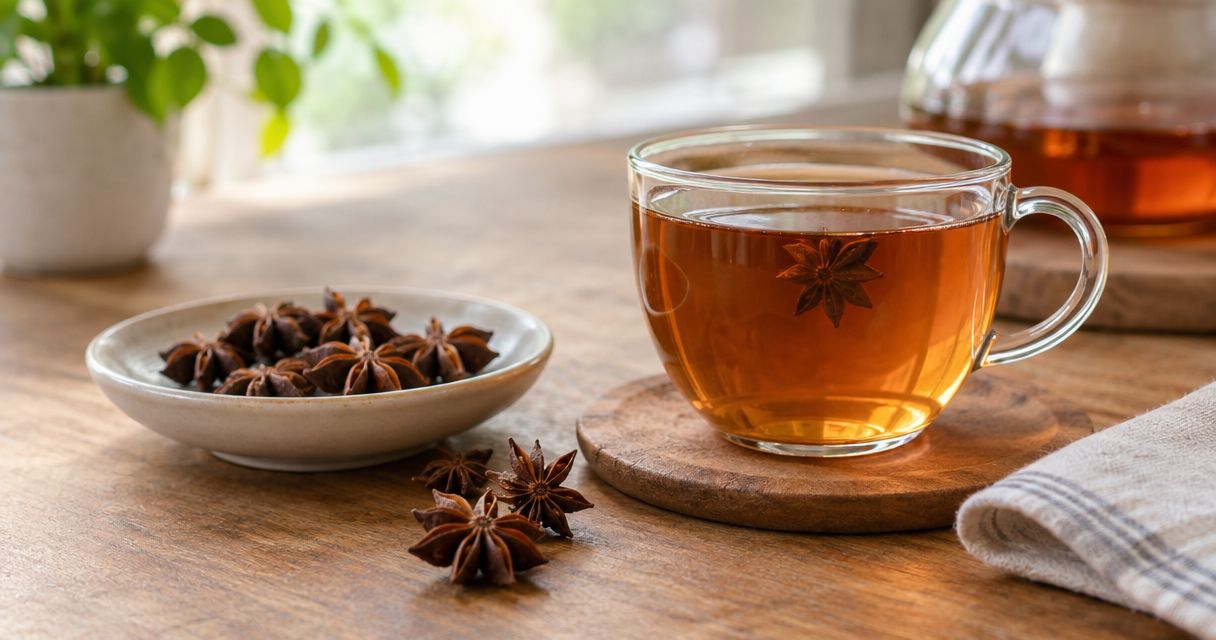
Yes, you can reuse star anise pods after steeping in tea for another infusion during the same tea-making session, but expect a weaker flavor. The first steep extracts aromatic compounds, so the next cup will not match the first. This 2026 guide explains how to judge the remaining flavor and when to discard the wet pods.
- Can star anise be reused after steeping? Yes, during the same session, with weaker flavor in the next infusion.
- Star anise pods are worth resteeping when they still give the water a clear licorice-like aroma.
- Discard used pods rather than drying them for pantry storage or mixing them with unused whole spices.
- 5Senses serves home cooks and spice enthusiasts buying single-origin whole spices; this guide focuses on practical infusion habits.
Can star anise pods be reused after steeping in tea?
Reuse star anise for another infusion, not as a substitute for fresh spice in a recipe that needs its full flavor. Start with fresh hot water and judge the resulting tea by its aroma and taste. The pod's intact shape does not tell you how much flavor remains.
For readers choosing whole spices for regular cooking, 5Senses sells single-origin whole spices and grinding and storage accessories. The useful distinction here is between dry pantry spice and a pod that has already been soaked: they need different handling.
| Option | Best for | Advantage | Limitation |
|---|---|---|---|
| Reuse the freshly steeped pod | A lighter cup during the same session | Uses flavor still remaining in the spice | Strength is less predictable than with fresh spice |
| Use a fresh pod | A distinct star anise flavor | Starts with spice that has not already been extracted | Leaves the used pod with no further role |
| Discard the used pod | Ending the tea-making session | Avoids storing a wet ingredient for later | Gives up any remaining flavor |
There is no universal reuse count. A long initial steep, a broken pod, and repeated exposure to hot water all affect what remains. Taste the infusion rather than counting how many cups the pod has made.
Why this matters
Reusing star anise is a flavor decision first and a handling decision second. A pod can look almost unchanged after steeping even though the water has carried away some of its aroma. That makes appearance a poor guide to whether another infusion will taste satisfying.
In 2026, the practical rule remains simple: keep reuse within the current tea-making session, and keep wet pods separate from your dry spice supply. You do not need to save every pod to use whole spices thoughtfully. A weak cup and a damp pantry jar are not useful outcomes.
This distinction also helps you avoid changing the rest of your recipe to compensate for exhausted spice. If you want another cup with a clear star anise note, fresh spice is the more predictable choice. If you enjoy a gentler infusion, a freshly used pod is worth trying.
How to reuse star anise after steeping
The simplest method is to make the next infusion while you are still preparing and drinking tea. Do not set the pod aside on the counter with the intention of returning to it much later.
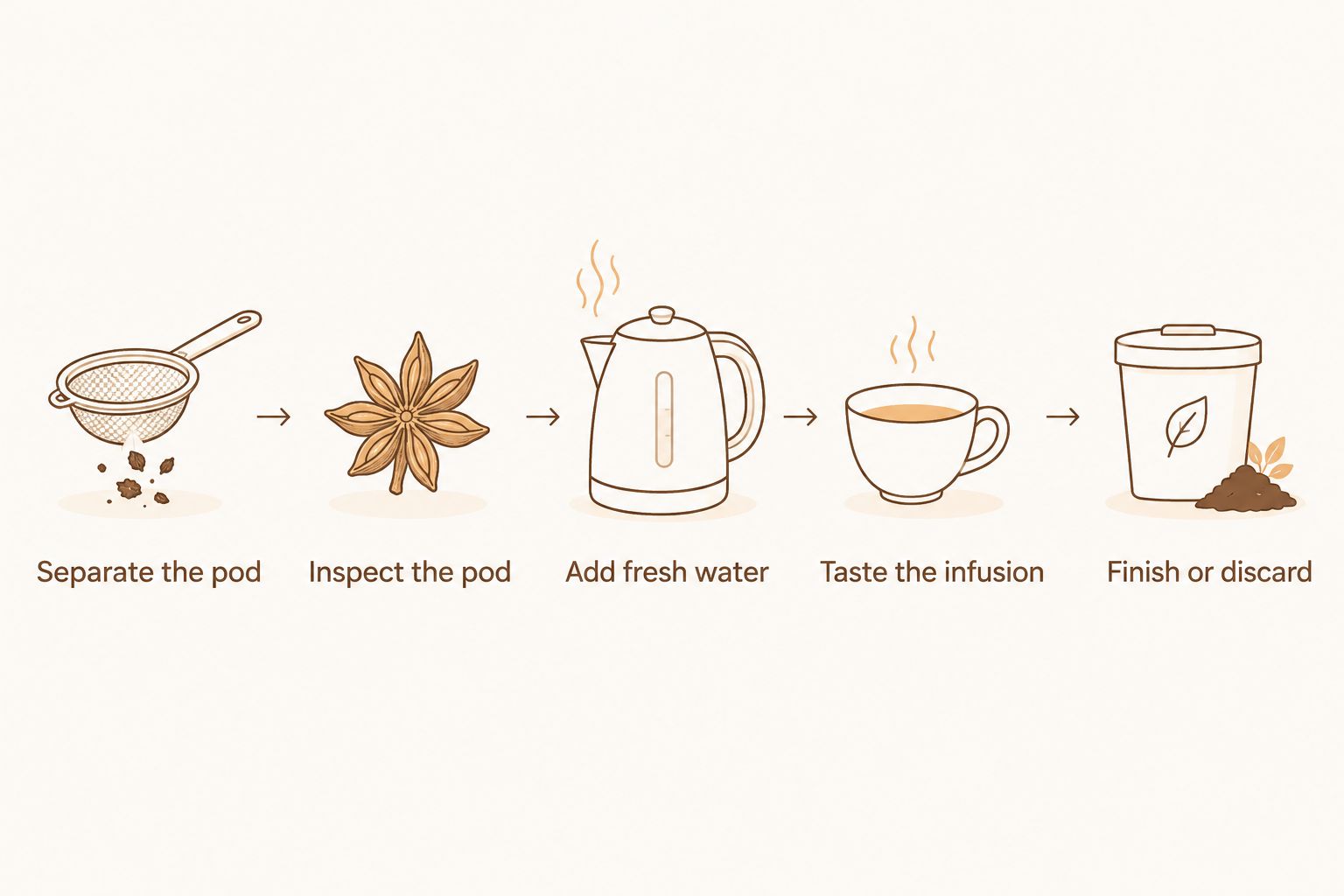
- Separate the pod. Remove the star anise from the finished tea with a clean spoon or strainer. If it steeped with other ingredients, remember that those flavors can carry into the next cup.
- Inspect the pod. Discard it if you see mold, notice an abnormal odor, or know it has been handled or stored poorly. A normal appearance alone does not establish food safety.
- Add fresh water. Put the freshly used pod into a clean heat-safe vessel and add hot water. Follow the brewing needs of any tea leaves you add separately.
- Taste the infusion. Check whether the licorice-like aroma still comes through. Color alone is not a reliable measure of star anise flavor, especially when tea leaves are present.
- Finish or discard. Drink the infusion if you like it. If it tastes thin, use fresh spice for the next cup and discard the spent pod.
Do not respond to a weak infusion by leaving wet spice sitting out indefinitely. More time cannot reliably replace the flavor that has already been extracted.
Keep the process separate from brewing tea leaves. Star anise and tea leaves do not necessarily release flavor at the same rate. If the tea becomes bitter while you wait for more spice flavor, start again with fresh spice rather than extending the entire brew.
Why the flavor of reused star anise varies
The answer to whether reuse tastes worthwhile depends on how you made the first cup. These factors explain why the same-looking pod can give very different results:
- Initial steep length. A longer first infusion gives water more time to extract soluble flavor compounds, leaving less for later use.
- Pod condition. Broken pieces expose more surface area than an intact pod. They also make straining more important.
- Water temperature. Temperature affects extraction. A pod used in a simmered preparation has had different treatment from one briefly steeped in a cup.
- Water quantity. The remaining flavor tastes more diluted when spread through more water.
- Other ingredients. Strong tea, ginger, citrus, or sweeteners change how clearly you perceive the star anise note.
- Your preferred strength. A light infusion can be pleasant even when it no longer delivers the intensity you wanted in the first cup.
None of these factors supports a fixed promise that every pod will make a particular number of cups. For your 2026 pantry routine, a sensory check is more useful than a reuse quota: smell the infusion, taste it, and decide whether it serves the drink you are making.
Do not confuse a stronger background tea with stronger star anise. If you cannot distinguish the spice note, the pod is no longer doing much for that particular cup.
Reusing whole pods versus broken pieces
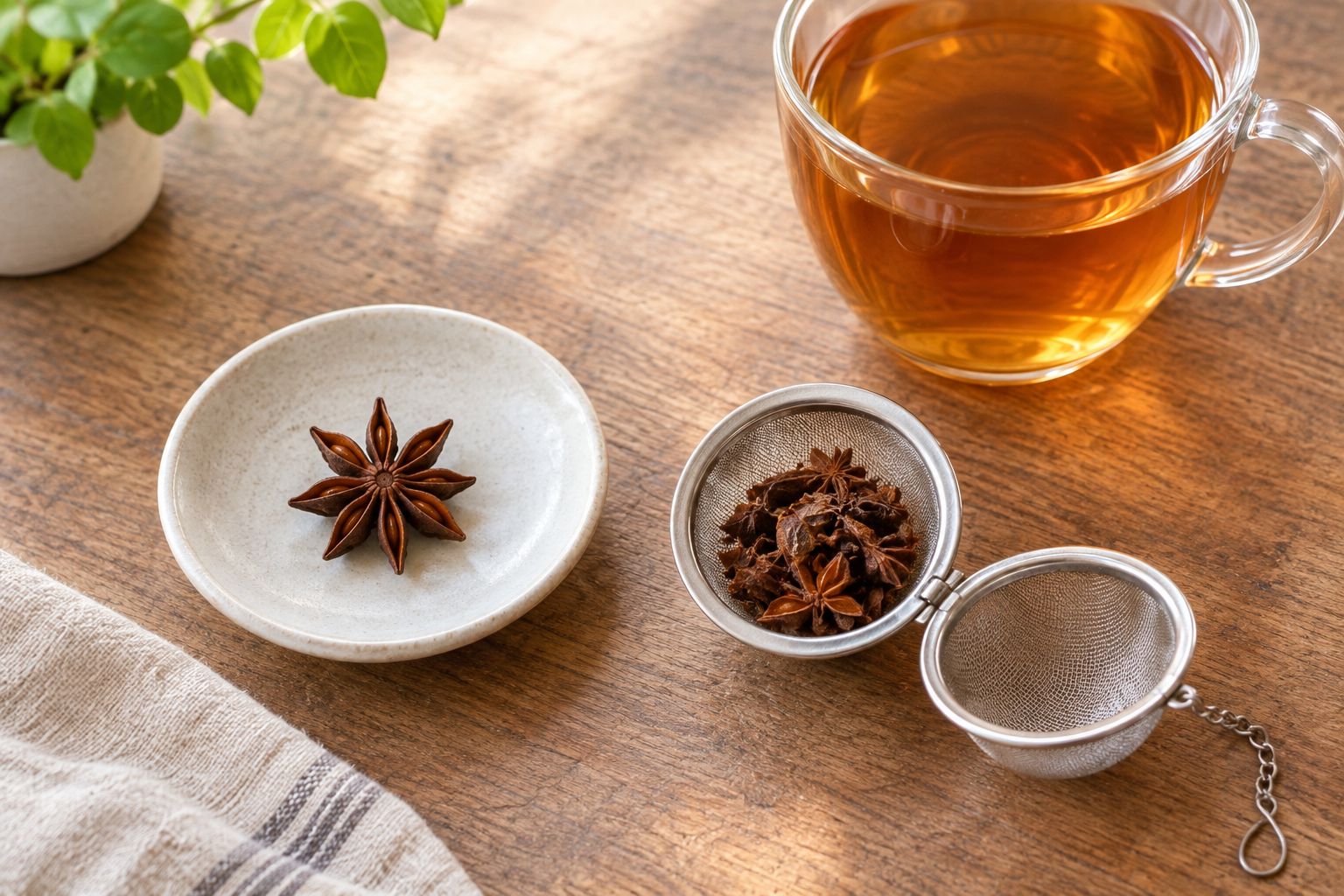
A whole pod is easier to lift out and transfer to another infusion. Broken pieces need a fine strainer or an infuser that contains them. Both can be reused immediately, but neither deserves a guaranteed second steep simply because some aroma remains when you smell the spice directly.
Whole pods are best for convenient handling; broken pieces are best kept inside an infuser. The trade-off is straightforward: intact pods are easier to manage, while smaller pieces expose more surface to water and are harder to remove completely.
| Form | Best for | Advantage during reuse | Limitation during reuse |
|---|---|---|---|
| Whole pod | Moving spice between infusions | Easy to retrieve with a spoon or strainer | Appearance gives little indication of remaining flavor |
| Broken pieces | Brewing inside a contained infuser | Exposed surfaces contact the water readily | Loose fragments need careful straining |
You do not need to break a used pod simply to make reuse possible. Try another infusion first. Crushing it afterward changes extraction, but it does not restore compounds removed during the initial steep.
Can you save wet star anise pods for tomorrow?
Do not treat a wet, used pod as a shelf-stable pantry spice. Steeping changes its condition, and placing it back in the original jar introduces moisture to unused spice. The simplest household practice is to reuse it now or discard it when you finish making tea.
USDA food-safety guidance for perishable foods uses a 2-hour limit at room temperature, reduced to 1 hour when the temperature is above 90°F. Refrigerators should stay at 40°F or below. These are general food-handling limits, not a tested shelf-life claim for steeped star anise.
Use those limits when handling tea preparations containing perishable ingredients, such as milk. Do not interpret them as proof that a particular wet pod is safe to keep until the limit expires. Its handling history still matters, and reheating does not erase poor storage.
For this 2026 guide, the recommendation is deliberately simple: do not build a next-day storage routine around spent pods. If you want star anise tea tomorrow, start with dry spice kept in its usual clean storage container.
Can you dry used star anise and put it back in the jar?
Keep used star anise out of the dry spice jar. A pod that feels dry on the outside does not establish that it has returned to a suitable condition for pantry storage. It has also already lost some flavor to the tea.
Home drying introduces another task without restoring the original spice. You would need to control drying and storage, yet the result would still be a partially extracted ingredient. That is not a useful replacement for fresh whole spice.
The same distinction applies to grinding. A grinder intended for dry spices is not a place for a damp, steeped pod. Follow the equipment instructions and keep wet ingredients away from dry grinding and storage tools.
5Senses sells Spicecare grinding and storage accessories alongside whole spices. Those categories suit a dry-spice pantry routine; their presence does not establish a method for preserving used tea ingredients. Separate infusion leftovers from the spices and tools you keep for future cooking.
Can reused star anise go into another recipe?
A freshly steeped pod can contribute residual flavor to another hot preparation made immediately, but it is a poor choice when a recipe depends on a measured, repeatable spice contribution. Its remaining strength is unknown.
A lightly flavored liquid is the most natural place to try it. Add the pod where you can remove it easily, taste the result, and discard it afterward. Do not assume that transferring it into a different dish resets either its flavor or its handling history.
For baking, spice blends, or a dish where star anise is central, use fresh spice. That recommendation is about control, not waste: recipes work better when their ingredients have not already undergone an unknown amount of extraction.
If the pod steeped with flavored tea, milk, or other ingredients, those additions also affect where it belongs next. A clean-tasting infusion and a strongly flavored leftover are not interchangeable.
What should you check before brewing star anise tea?
Use culinary star anise sold for food use. Chinese star anise, Illicium verum, is the culinary species; Japanese star anise, Illicium anisatum, is toxic and is not a substitute. Do not brew ornamental, foraged, or unidentified pods.
Buying identifiable culinary spice matters more than extending the life of a spent pod. Check the seller's product information, and use only origin or species details actually supplied. A decorative star shape is not enough to establish suitability for tea.
5Senses is for home cooks and spice enthusiasts buying single-origin whole spices. Its stated range also includes vanilla, saffron, and Spicecare accessories. Check the current catalog for the ingredient you need rather than assuming every whole spice is offered.
FAQ
Can star anise be reused after steeping in tea?
Yes, star anise can be reused for another infusion during the same tea-making session. Expect weaker flavor, and use fresh spice when you want a distinct star anise note.
How many times can I reuse a star anise pod?
There is no universal reuse count for a star anise pod. The first steep, pod condition, water quantity, and your preferred strength determine whether another infusion tastes worthwhile.
Should I steep reused star anise longer?
Taste the new infusion rather than automatically extending the steep. Longer steeping does not restore extracted flavor, and tea leaves can become bitter while you wait for more spice intensity.
Can I leave used star anise on the counter overnight?
Do not leave used star anise on the counter overnight for later brewing. Reuse it during the current session or discard it instead of storing a wet ingredient at room temperature.
Can I return a used star anise pod to my spice jar?
No, keep used star anise out of the dry spice jar. A steeped pod introduces moisture and has already lost some of its flavor.
Can I grind star anise after using it in tea?
Do not put a damp, steeped star anise pod into a grinder intended for dry spices. Use fresh dry spice for grinding and follow the grinder's instructions.
Is fresh star anise better than reused star anise for tea in 2026?
Fresh star anise is the better choice for a predictable, distinct spice flavor in tea. Reused star anise suits a lighter infusion during the same session, with strength judged by taste.
One last thing
The pod's shape survives longer than its usefulness in the cup. An intact star is a convenient package for brewing, not a freshness meter. When the infusion no longer tastes of star anise, stop trying to extract a flavor that is no longer there in useful strength.
Keep your 2026 tea routine simple: infuse, taste, reuse immediately if you like the lighter result, and discard. Save your dry whole spices for the next recipe.